
Why Only 13.2%? Exploring the Gender Gap in Indian Startups
Underrepresentation might be your Startup’s biggest loss.

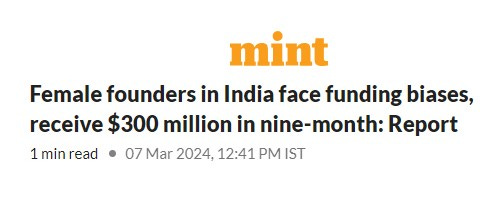
In 2023, a mere 13.2% of startup founders identified as women, highlighting a persistent gap where men outnumber women founders by a nearly six-to-one ratio. Despite India being the world's third-largest startup ecosystem, women's representation remains low, constituting only 35% of employees in startups. This lack of inclusion not only hinders equal opportunity but also holds back the full potential of our startups. The landscape of Indian startups is changing, but not fast enough when it comes to gender diversity.
There is also the fact that the definition of ‘gender’ itself has evolved in recent decades, and India’s startup culture is yet to catch up. Traditionally, startup culture has revolved around a binary view of gender – male and female. However, the landscape is evolving. The term "gender minority" encompasses individuals who identify outside this binary. This includes people who identify as transgender, non-binary, genderqueer, agender, and more. It's important to distinguish between gender identity (a person's internal sense of being male, female, or something else) and sex assigned at birth (based on physical characteristics).

The Price of Exclusion
While women face their own set of challenges in the workplace, gender minorities often experience a different kind of discrimination in startups. Here's how:
Microaggressions and Misgendering: Constant misgendering through pronouns or assumptions about their identity can create a hostile work environment.
Lack of Visibility: The absence of role models and an invisible LGBTQ+ community within the startup can make it difficult for gender minorities to feel welcome.
The "Brogrammer" Culture: A culture dominated by a certain stereotype can make it intimidating for gender non-conforming individuals to express themselves authentically.
Limited Access to Funding: Venture capitalists and investors may be less likely to back startups with founders who are gender minorities, perpetuating a cycle of exclusion.
Building an Inclusive Hiring Pipeline

Building a Safe Space
Inclusion goes beyond hiring. It's about creating a work environment where everyone feels valued. Here's how:
Respect and Recognition: Start with something simple – pronouns! Include options for gender pronouns in application forms, employee profiles, and email signatures. Consistently use the pronouns an employee identifies with.
Everyone Belongs: Provide gender-neutral restrooms and locker rooms. It's a small gesture with a big impact.
Education is Key: Organise workshops on gender identity and LGBTQ+ inclusion. Foster understanding and create a safe space for open dialogue.
Celebrating Diversity: Recognise the unique experiences and perspectives that gender minorities bring to the table. Host events or discussions during Pride Month or other relevant occasions.
Shattering the Glass Ceiling: AMA with Rammya Nair
In this edition, we're thrilled to feature a Q&A with Rammya Nair, a leading voice in the Indian startup ecosystem who's breaking barriers and paving the way for a more inclusive future. Rammya shares her insights on the challenges and opportunities women face in the world of entrepreneurship, and how fostering diversity can fuel innovation and growth.

Have you encountered any specific instances of gender bias in your entrepreneurial journey? If so, how did you navigate them?
I have encountered gender bias, and for me, it was a bit of a brute shock. When I came back from my maternity leave, I had already spent four and a half years in the organisation, but the expectation was to redefine and build my credibility again. That six-month gap affected how I was seen as a professional in the environment. Many women who go through maternity leave wonder where they will be once they return or most don't return at all, finding a new place to work instead.
That was my story. How did I navigate that? I had a very supportive husband who is also an HR professional and understood my circumstances. He played a big role in comforting me. My manager was also supportive and helped me navigate that journey because the first year with the kid while starting back at work was never easy. It was a support system, and I also decided to work hard to break that bias. I took it as a challenge and, with that support system, was able to reestablish myself and gain my confidence. I was very low on confidence when I realised the truth of coming back from maternity leave.
From your experience, what are some of the biggest challenges women face when aspiring to become startup founders?
This is something I have been pondering upon, and this is my very personal opinion. Having been a student of behavioural sciences and transaction analysis, I believe a lot of us are victims of the system and the belief system society sets for us, especially in India. I can only comment about India as I have very little knowledge about how women are treated in other societies. From childhood, there's a constant comparison, like women cannot play football or mechanical engineering is not for women. There's always a persona society tries to portray for you and takes decisions on your behalf. This has inherently made women think in a particular way, starting off from a status of low confidence, low risk-taking, being the caregiver, and feeling guilty if taking off for maternity. They always start on the back foot, so there's that much more space and time needed to work towards finding their grip and confidence back.
I believe a lot needs to be changed in society to change people's mindsets. The biggest challenge a woman faces is her own inhibitions and belief system that they are not good enough or need to feel guilty or will not live up to society's expectations if they do something different from the norms. The work has to be done within every woman first, and for that, there has to be an encouraging ecosystem set in, and all of us have to contribute towards it. But the mindset shift has to happen inside every woman. That's my understanding.
What are some of the concrete benefits diverse teams bring to startups, especially in terms of innovation and growth?
We need very structured solutions. I believe the right way to say it is inclusion and diversity because that's the culture you have to build first. You need to build structured solutions to bring about that culture. For example, my organisation has benefits like appraisals for maternity employees done before they leave. The manager is supposed to record so there's no loss of data during the six months of maternity break. When they come back, HR takes care to find a role for the person, putting them in comfort, which is very assuring of an organisation practicing inclusion as a culture.
From a growth mindset and inclusive culture mindset, having allyship and support groups helps people understand what inclusion as a culture means. We make sure a certain percentage of our hiring pipeline is from diverse groups and mark roles where diverse team members can work. These are systematic investments and deeper change management steps which will help the organisation. These are two or three things I can remember about innovation, focusing more on deeper cultural changing steps we are taking.
How do you think companies can build a strong culture of diversity in hiring practices to create well-rounded and innovative teams?
We're in an era where we are still looking at quota systems or reservations. I personally believe there's nothing wrong in doing so, even in the corporate world. Just like in the private sector, politics, or a simple example of IIT colleges having a women quota, in the corporate world, we have to deal with inclusion and diversity in a very similar approach.
A few things we do include earmarking roles that should only be for diversity, and setting a percentage around pipelining. In my personal experience, I have always made sure 60 to 70 percent of the pipeline is women, so that we are fair to men but also have better conversion in terms of women. We set targets for diversity, cutting across the hierarchy. That means paying attention to senior leadership and investing in them systematically to reach that number. I also like how boards now have a percentage of women representatives at the table. These are very systematic approaches that most of the corporate world are doing, and so is my company.
We earmark roles, fix a percentage for pipelining, and set a certain diversity percentage across the hierarchy, including a fixed percentage for leadership roles. This leads to investment in women and mentoring and coaching them through specific initiatives. For example, "Girls Can Code" is something Flipkart does regularly to address the gap in the engineering and product industry, where a lot of women do not opt for that profession. There's a scarcity of women in that skill, so that is being taken care of.
A lot of initiatives are systematically done to address this. These then become a P0 matrix for us, where every HR is putting their head and heart into getting this done. This systematically makes your organisational design and diversity very healthy, and eventually, it will help change the culture itself in the next 10 years, maybe.
The future of Indian startups is bright, and it's a future where everyone has a seat at the table. Let's work together to create a more inclusive and innovative landscape, where diverse voices and perspectives fuel groundbreaking ideas. Thank you for joining us in this important conversation.
Don’t leave us yet!
MetaMorph isn't your typical HR firm. We're a 360° HR Advisory firm dedicated to helping startups scale, evolve, and grow. We’ve helped more than 220 startups and multiple hires (and counting), providing them with the platform and opportunities they deserve.
We look forward to bringing you more exciting initiatives aimed at building a stronger and more inclusive tech ecosystem. Stay tuned for future events and updates through our newsletter and by following us on social media.
Thank you for being a part of the MetaMorph journey!